
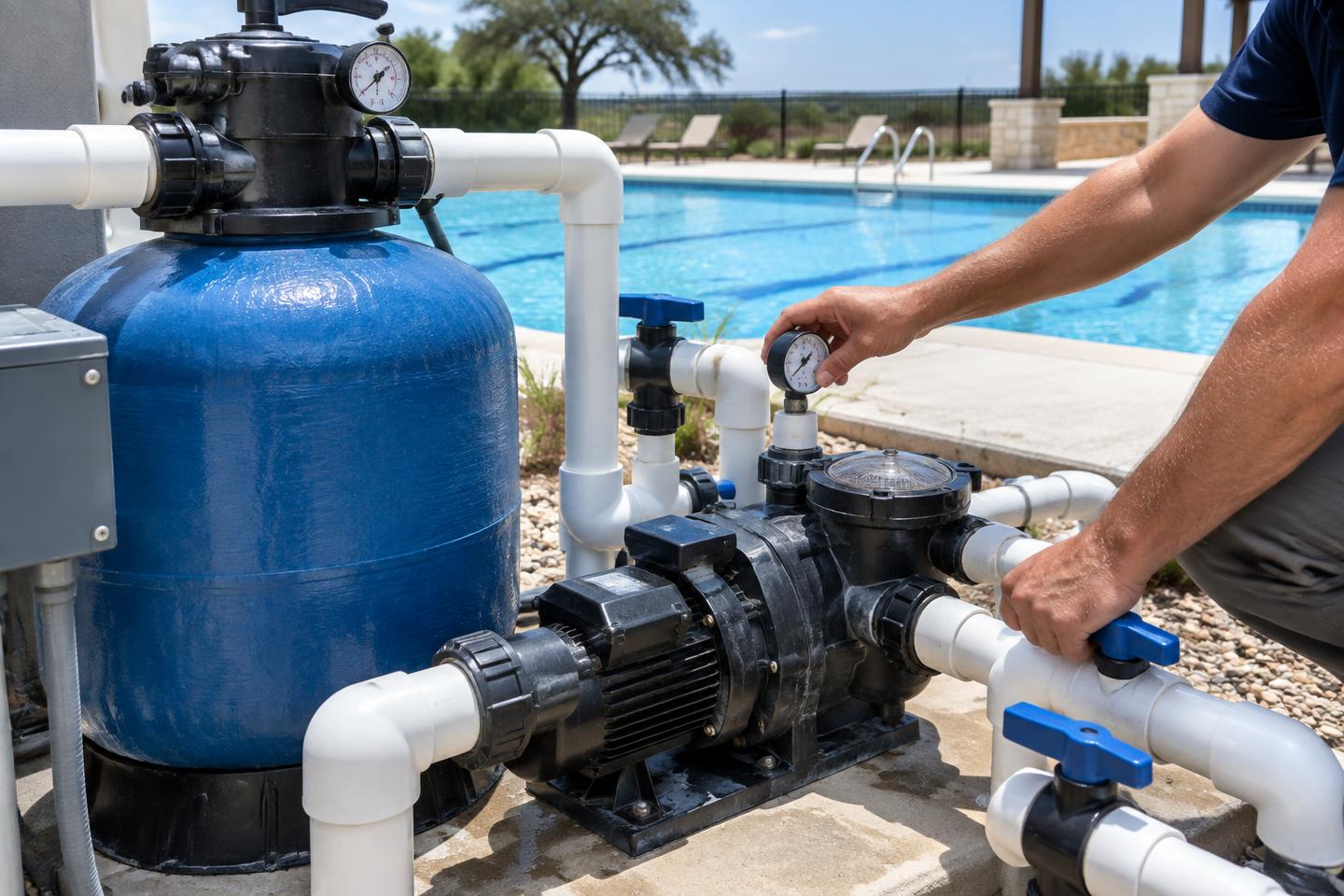
Commercial pools need a scope built around the way the property operates. For pump & filter service, that means looking at the pool, the people responsible for it and the conditions that change between visits—not just completing a generic checklist.
What this service can cover
The final scope depends on equipment, use and site responsibilities. These are the tasks to discuss during a property review.
Checking baskets, strainers and accessible connections.
Assessing pressure and flow against known normal conditions.
Inspecting filter cleaning needs and media condition.
Flagging leaks, air intrusion and unusual noise.
Read the circulation system as a whole
A pressure gauge is a useful clue, not a standalone diagnosis. Rising filter pressure can point to a loading filter; unexpectedly low pressure may indicate inadequate flow, suction restrictions or a gauge problem. Compare readings with this system's clean-filter baseline and observe return flow, pump sound and whether the pump holds prime.
The path from skimmer and main drain through baskets, pump, filter and returns contains several points where performance can fall off. Safe access and the site's equipment configuration determine which checks can be performed during a visit.
Filter care depends on equipment type
Sand, cartridge and diatomaceous earth filters have different cleaning and media requirements. A universal backwash schedule is not appropriate. Follow the manufacturer's procedure and the facility's normal pressure range; record both the before and after conditions so the next visit can spot a filter that loads unusually fast.
Repeatedly dirty or cloudy water despite adequate test readings warrants a look at circulation time, bypasses, damaged media, channeling or other filtration problems. Do not assume a chemical adjustment alone will restore clarity.
Reduce avoidable interruptions
Small signs—air in the pump basket, a drip at a union, a louder bearing or a valve that no longer moves freely—are worth noting before a shutdown. A maintenance log should show which issue needs routine attention and which could affect safe operation now.
After service, check that valves and controls are returned to the intended position. A system left in a cleaning or bypass configuration can undo the benefit of the work and create a new water-quality problem.
When to take a closer look
- When clarity falls even with acceptable chemistry.
- When pressure changes abruptly.
- When a pump runs loudly or struggles to prime.
What to have ready for a conversation
- Filter type and clean-filter baseline pressure
- Recent cleaning or media replacement history
- Changes in clarity, return flow, leaks or pump noise
Questions to settle before work begins
What is the normal clean-filter pressure for this system?
When was the media last serviced?
Are valves clearly labeled for staff?
How to evaluate the result
Agree on a starting condition before work begins: recent logs, visible symptoms, equipment readings and any open findings. After the visit, compare those records with what was actually observed and corrected. A completed task and a resolved problem are not always the same thing; note what still needs monitoring, approval or a second check.
If a condition affects water clarity, circulation, disinfection or safe access, the facility team should use its closure and escalation procedure rather than waiting for the next scheduled visit. Reopening decisions belong with the responsible operator under the requirements that apply to the site.
CPO oversight and health-department rules
A Certified Pool & Spa Operator (CPO) credential is training, not a permit or a substitute for the facility operator’s responsibilities. Identify who is trained to oversee the pool, who performs and records tests during open hours, and who has authority to close it when conditions are unsuitable. Check the qualifications required for your particular facility with its regulator; this page does not establish that any member of our team holds a CPO credential.
Texas public-pool requirements are published by the Texas Department of State Health Services. Permits, inspections and additional rules may be administered by the city or county health department responsible for the property address. Do not assume City of Houston rules apply to every suburb. Keep permits, water logs and inspection correspondence available, and confirm the current requirements directly with the responsible authority.
For a checklist of information to gather before an inspection, see inspection preparation. A service visit does not certify compliance or replace official inspection.
Questions property teams ask
When should a filter be cleaned?
Use the equipment manufacturer's instructions and that system's clean-filter baseline rather than an identical interval for every pool.
What if the water stays cloudy after treatment?
Review filtration, circulation and water readings together. A chemical adjustment alone may not resolve a flow or media problem.
Facility requirements vary by address, pool type and authority. Confirm site-specific obligations with the applicable local authority. Service scope and availability are confirmed for each property.